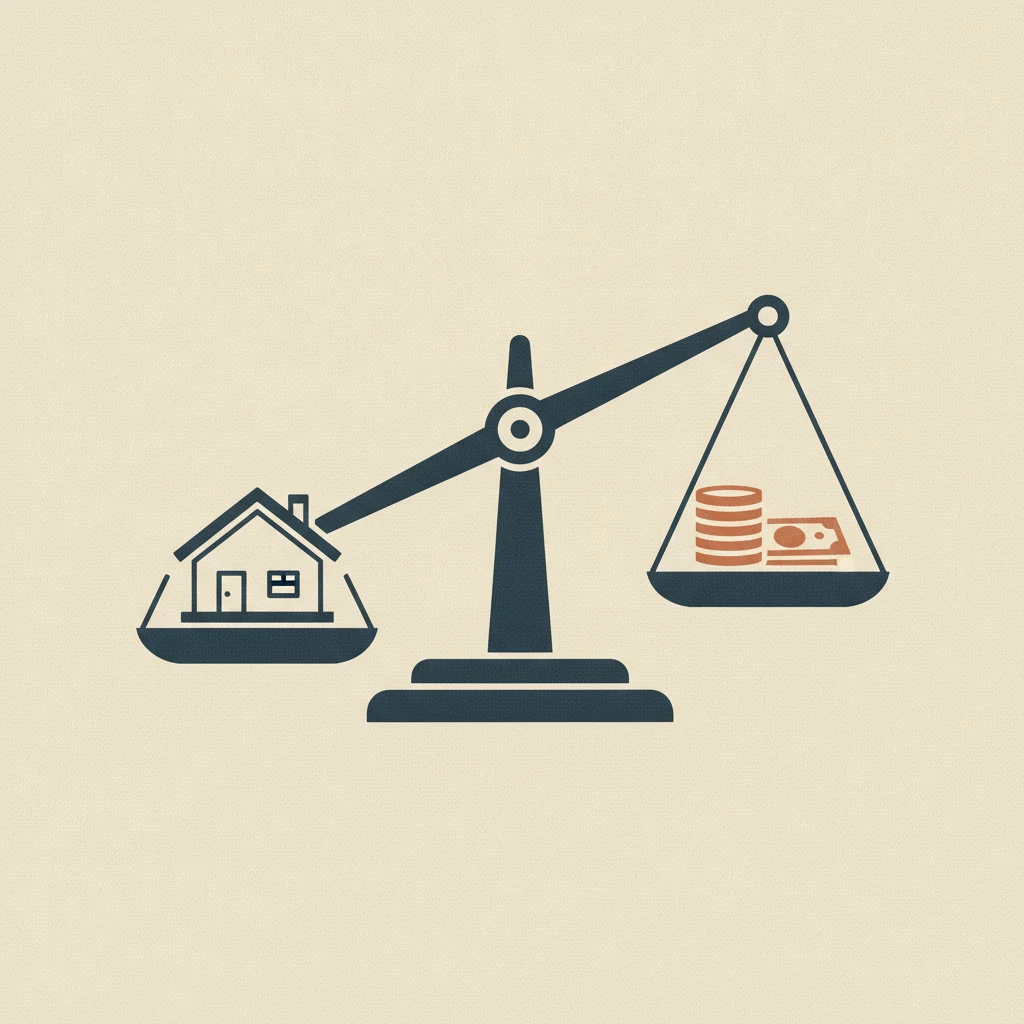
A reverse mortgage is neither a scam that steals your house nor the free money the ads imply. It is an expensive, sometimes-right financial trade: you convert home equity you can't easily spend into cash you can, and in exchange you pay real costs and hand back a shrinking estate. Whether it's a good deal depends entirely on your situation — and on reading the fine print the sales pitch tends to skip.
The honest way to look at one is as a two-sided ledger. Every advantage has a matching cost sitting right next to it. So instead of a list of "pros" followed by a separate list of "cons" — the format that lets a salesperson walk you through the upside and rush the downside — we've paired each pro directly with its catch. Read them together.
One ground rule before the pairs: nearly all reverse mortgages in the U.S. are HECMs (Home Equity Conversion Mortgages), insured by the FHA. To qualify, the youngest borrower must be 62 or older, it has to be your primary residence, and HUD-approved counseling is required before you can proceed. That counseling session is not a formality — it's the single best free hour you can spend on this decision.
Pro 1: No monthly mortgage payment ↔ the balance compounds against your estate
The headline benefit is real. You draw on your equity and make no monthly loan payments for as long as you live in the home. For a house-rich, cash-poor retiree on a fixed income, that freed-up cash flow is often the entire point.
The catch: skipping the payment doesn't make it free — it makes it grow. The interest you'd normally pay each month, plus an ongoing FHA mortgage-insurance premium of about 0.5% per year, is added to what you owe. The balance compounds, and it is largest at the very end, when the home is sold. A reverse mortgage is a loan that runs in reverse: the debt climbs while the equity falls.
Pro 2: You keep the title and stay in your home ↔ you must keep paying taxes, insurance, and upkeep
You remain the legal owner. A reverse mortgage is a lien against the home, not a sale of it, and as long as you meet the obligations you cannot be forced out simply for having the loan.
The catch lives in the phrase "meet the obligations." You must keep paying property taxes, homeowners insurance, and basic upkeep, and keep the home as your primary residence. Falling behind on any of those is a default — and default is the most common way people actually lose a home to a reverse mortgage. The CFPB's reverse mortgage guidance flags this as the risk borrowers most often underestimate. If money is already tight enough that the tax bill is a stretch, that is a warning sign, not a detail.
Pro 3: Non-recourse protection ↔ you pay for that insurance, upfront and ongoing
HECMs are non-recourse. Neither you nor your heirs will ever owe more than the home is worth at sale — even if the loan balance has grown past the home's value. If the house is worth less than the debt, FHA insurance covers the gap. Your other assets are never on the hook.
The catch: that protection is something you buy, not something you're given. It's funded by an upfront mortgage-insurance premium of 2% of the home's value (capped at the FHA lending limit) plus the ongoing ~0.5%/year premium that accrues onto the balance for the life of the loan. Non-recourse is a genuinely valuable feature — it's just a priced one, and the price is real.
Pro 4: Flexible, generally tax-free cash ↔ the proceeds are far less than your equity
You can take the money several ways: a lump sum, a line of credit, or monthly payments (a set term, or "tenure" payments for as long as you live there). Because it's loan proceeds rather than income, the money is generally not taxed and generally doesn't affect Social Security or Medicare. (It can affect need-based benefits like Medicaid or SSI — one more thing to raise with your counselor.)
The catch: you never get anywhere near your full equity. The amount you can borrow — the "principal limit" — is only a fraction of the home's value, set mainly by the youngest borrower's age and current rates, and the upfront costs come out of that. Between the closing costs, the origination fee (2% of the first $200,000 of home value plus 1% above, capped at $6,000), and the principal-limit haircut, the net check is a lot smaller than "your home is worth $500,000" suggests. Total upfront costs often land somewhere in the five figures. Rather than trust any single quoted figure, run your own numbers in our reverse mortgage calculator — it shows both what you'd net and what it costs to get there.
Pro 5: You can't be forced out if home values fall ↔ it's very expensive if you move within a few years
Because the loan is non-recourse and tied to occupancy rather than a payment schedule, a drop in your local housing market can't trigger a margin call or force a sale. You stay put regardless of what Zillow says your home is worth.
The catch: all those upfront costs are front-loaded, and there's no long runway to spread them over if you leave early. Take a reverse mortgage and then move — into assisted living, closer to family, or a smaller place — within a few years, and you've paid a large fixed cost for a short-lived loan. A reverse mortgage rewards staying put for a long time and punishes moving soon. If there's a real chance you'll relocate within, say, five years, that alone can tip the math against it. This is exactly where the alternatives earn a look: a HELOC, a home-equity loan, or simply downsizing can be far cheaper ways to tap equity when the time horizon is short.
Pro 6: It supplements retirement income ↔ it shrinks the biggest asset most people leave heirs
Used well, a reverse mortgage turns a frozen asset into a spendable one — a line of credit for emergencies, a bridge until a pension or Social Security claim, or a floor under monthly expenses. For the right household it can be the difference between a comfortable retirement and a strained one.
The catch: for most American families, the home is the estate. The growing balance steadily eats the equity you'd otherwise leave to heirs, and by design it's largest at the end. That's not automatically a con — if funding your own retirement matters more than leaving the house intact, spending your equity is a perfectly rational choice. But it should be a choice you make with open eyes, ideally in conversation with the people who'd inherit, not a surprise they discover later. It's also worth knowing that non-borrowing-spouse protections exist — a younger spouse who isn't on the loan can usually remain in the home — but they come with conditions, so confirm the specifics before you rely on them.
So who is it actually right for?
The pattern across all six pairs is the same: a reverse mortgage is a good fit for a specific person — someone who is 62 or older, wants to stay in their home for the long haul, needs the cash flow, can comfortably keep up with taxes and insurance, and either has no heirs to worry about or has talked it through with them. For that person, the costs buy something worth having.
It's a poor fit for someone likely to move soon, already struggling to cover property taxes, hoping to leave the house to their children intact, or reaching for it as a quick fix without understanding the compounding balance. If any of those describe you, the honest answer is often "not this — or not yet."
The FTC's consumer guidance puts the core warning plainly: a reverse mortgage uses up the equity in your home, which means fewer assets for you and your heirs. That's not a reason to avoid one — it's the trade you're agreeing to. The whole job is deciding whether that trade is worth it for you.
Your next step
Don't decide this from an advertisement, and don't decide it from this page either. Do two concrete things. First, run your own numbers so you're looking at real figures — what you'd net, what it costs, and how the balance grows — instead of a brochure's best case. Then, if it still looks plausible, read our fuller walk-throughs of whether a reverse mortgage is a good idea and the exact eligibility requirements, and schedule the required HUD-approved HECM counseling session. It's low-cost or free, independent of any lender, and it's the step designed to protect you. Weigh the ledger with real numbers in front of you — then choose.
- HUD / FHA — Home Equity Conversion Mortgage (HECM) program (age 62+, primary-residence rule, required counseling, non-recourse, MIP, origination-fee formula).
- CFPB — Reverse mortgages consumer guidance (default via taxes/insurance/upkeep; balance growth; payout options).
- FTC — Reverse mortgages (equity erosion and impact on heirs).
Educational analysis, not individualized financial advice. We're independent and don't sell loans. See our methodology and disclaimer.