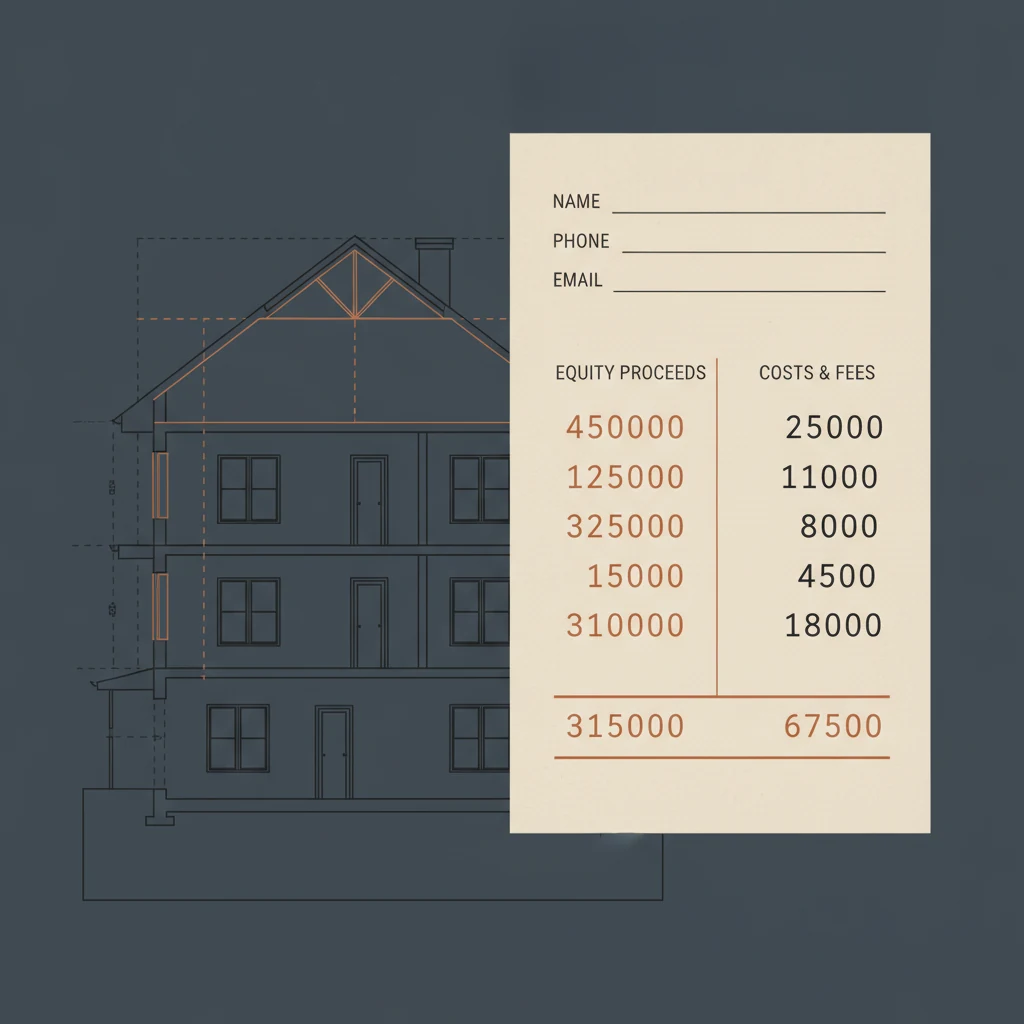
The form asking for your name and phone number isn't part of the calculation — it's the product. Estimating how much a reverse mortgage would pay you requires your age, your home value, your existing mortgage balance, and a current interest rate. It does not require your name, your phone number, or your email address. The reason most calculators ask anyway is structural: they exist to generate leads, not to give you independent answers.
Why reverse mortgage calculators almost always ask for your contact information
The reverse mortgage industry relies heavily on lead aggregators — companies that capture consumer intent during early research and sell those contacts to lenders. A qualified lead can fetch $20 to $100 or more per contact, which means a calculator connected to a lender or aggregator is worth considerably more as a lead-capture form than as a neutral financial tool. You arrive looking for a number; you hand over your contact information to "see results"; you've entered a sales pipeline.
The CFPB's reverse mortgage guidance and the FTC's consumer materials both specifically flag aggressive reverse mortgage marketing — unsolicited calls, misleading advertising, high-pressure tactics — as persistent consumer protection concerns. That pipeline starts the moment the calculator collects your phone number.
Some lenders and independent sites offer calculators that run without any contact information. They're less common on the major aggregator platforms, but they exist — and because they don't have a lead-sale incentive, they're more likely to show you the full picture, including the cost side that proceeds-only calculators tend to minimize.
What the math actually requires
A Home Equity Conversion Mortgage (HECM) calculation uses exactly four inputs. Your contact information is not among them:
| Input | Why it matters |
|---|---|
| Age of youngest borrower | Sets the Principal Limit Factor (PLF) — a HUD-published fraction of home value. Older borrowers receive a higher PLF because the expected loan term is shorter. |
| Home's appraised value | Capped at the FHA maximum claim amount ($1,249,125 for 2026). Value above that ceiling doesn't increase your proceeds. |
| Existing mortgage balance | Paid off first from your proceeds. Only equity above your current mortgage is available to you. |
| Expected interest rate | Higher rates lower the PLF and reduce proceeds. The rate used is a HECM benchmark expected rate, not your final quoted rate. |
A calculator that requires your name, phone, or email before displaying results is using the calculation as a funnel, not as a financial tool. The contact-info gate is a business model, not a technical requirement.
The cost side most calculators leave out
Even honest calculators that skip the lead-capture form often show only the proceeds estimate — how much you'd receive. The more important half of the ledger is what getting there costs you:
- Upfront MIP: 2% of your home's value (capped at the FHA limit). On a $400,000 home, that's $8,000 rolled into the loan at close.
- Origination fee: 2% of the first $200,000 of home value plus 1% above that — capped at $6,000.
- Ongoing MIP: 0.5% per year, accrued onto your growing balance every month for the life of the loan.
- Closing costs: Appraisal, title search, recording fees — typically $3,000–$12,000 depending on your location and home value.
- Compounding interest: At a 7.68% expected rate (HECM benchmark, August 2026), a loan balance roughly doubles in about ten years — even without drawing down additional proceeds.
The upfront costs alone typically run into five figures. On a $450,000 home, upfront MIP ($9,000) plus origination ($6,000, at cap) plus closing costs ($5,000–$8,000) means roughly $20,000–$23,000 comes out of your estimated proceeds before you receive anything. A calculator that shows only the gross proceeds number without subtracting those costs is giving you the best-case figure, not the real one.
How to run the numbers without personal information
Our calculator uses the official HUD HECM Principal Limit Factor table — the same 38-age × 128-rate lookup table that lender origination software uses — and runs entirely in your browser with no form submission, no lead, and no sales pipeline.
Run the Numbers — No Personal Information Required →The HUD PLF table has been in effect since October 2, 2017. The FHA maximum claim amount for 2026 is $1,249,125 (HUD Mortgagee Letter 2025-22). Rates in the calculator default to current HECM benchmark levels and can be adjusted. The 10-year balance projection uses the compounding-interest methodology from our methodology page.
Four inputs. Two outputs: your estimated net proceeds after upfront costs, and the compounding balance and equity projection over ten years. No phone call follows.
What the calculator can't tell you
Running the numbers yourself is the right first step — understanding the magnitude of the transaction before any sales conversation is how you maintain negotiating position and avoid surprises. But the step that follows, if the numbers look plausible, is a required HUD-approved counseling session. By law, no HECM can proceed without one.
Counselors are independent of lenders, the session is low-cost or free, and it covers what no calculator can: what happens if you need to move to assisted living, how non-borrowing-spouse protections work, what your specific tax and insurance obligations are, and whether one of the alternatives — a HELOC, a home-equity loan, or downsizing — fits your situation better. The CFPB's counseling resource and HUD's counselor directory are the places to find one.
"The session is where questions like 'what happens when I need to move?' get answered by someone who isn't trying to sell you anything."
Where to go next
Start with the calculator and the real numbers in front of you. Then read our fuller walk-through of whether a reverse mortgage is right for your situation and the side-by-side comparison of all home-equity options. If the math still holds up after all that, the HUD-approved counselor — not the lender — is your next call. You can also review a worked example of a real HECM calculation to see how the numbers move with different inputs.
One reason to do the research before any lender contact: it changes the conversation. A borrower who has already run the numbers, read the honest accounting of the pros and cons, and completed counseling is negotiating from a very different position than one who first encounters the costs in a lender's presentation. The calculator is free. The lead is not.
- HUD / FHA — Home Equity Conversion Mortgage (HECM) program (PLF table, FHA max claim amount, origination-fee formula, MIP rates, counseling requirement, HUD Mortgagee Letter 2025-22).
- CFPB — Reverse mortgages consumer guidance (marketing practices, lead-generation concerns, counseling resources).
- FTC — Reverse mortgages (high-pressure tactics, aggressive marketing practices, consumer protections).
Educational analysis, not individualized financial advice. We're independent and don't sell loans. See our methodology and disclaimer.